
Coal Clinker & Slag as Supplementary Cementitious Materials (SCMs) and Structural Lightweight Aggregates
Repurposing coal combustion by-products: bottom ash, boiler clinker, and granulated blast furnace slag (GGBS) as pozzolanic SCMs and structural lightweight aggregate in African infrastructure.
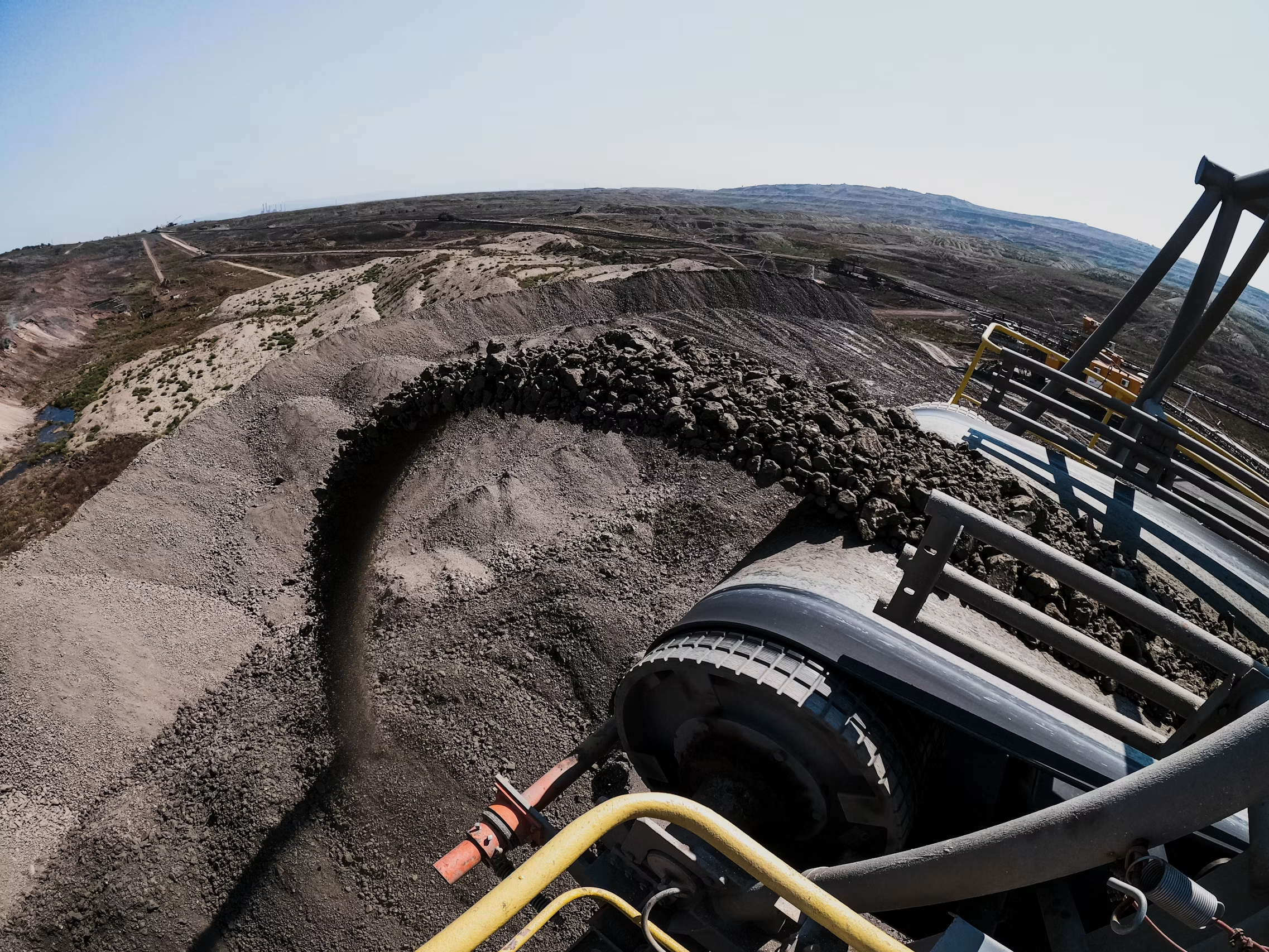
Industrial Circular Economy in African Construction
As urbanization accelerates across Africa, the demand for affordable building materials, blended cements (CEM II, CEM IV), and structural lightweight concrete has surged. Concurrently, thermal power plants, metallurgical smelters, and industrial boilers generate significant volumes of bottom ash and fused coal clinker.
Transforming these combustion residuals into Supplementary Cementitious Materials (SCMs) and graded aggregates creates substantial economic value while cutting embodied carbon.
---
Chemical & Physical Characteristics of Coal Clinker vs. Fly Ash
| Parameter | Fused Coal Clinker / Bottom Ash | Pulverized Fly Ash (Class F) | Granulated Blast Furnace Slag (GGBS) | | :--- | :--- | :--- | :--- | | Particle Form | Porous, angular, fused clinker nodules | Spherical micro-beads | Angular glassy particles | | Specific Gravity | 2.10 – 2.45 g/cm³ | 2.20 – 2.60 g/cm³ | 2.85 – 2.95 g/cm³ | | Silica ($ ext{SiO}_2$) | 45.0% – 58.0% | 48.0% – 60.0% | 32.0% – 38.0% | | Alumina ($ ext{Al}_2 ext{O}_3$) | 20.0% – 30.0% | 22.0% – 32.0% | 10.0% – 16.0% | | Calcium Oxide ($ ext{CaO}$) | 2.0% – 8.0% | 1.5% – 6.0% | 38.0% – 44.0% | | Reactivity Mechanism | Pozzolanic (requires fine grinding) | Pozzolanic | Latent Hydraulic |
---
Structural Applications in Modern Civil Works
1. Lightweight Structural Concrete Blocks (Cinder Blocks)
- Graded coal clinker (2.36mm – 10mm) replaces conventional dense gravel aggregate. - Density Reduction: Concrete density decreases from $2,400\text{ kg/m}^3$ to $1,650\text{--}1,850\text{ kg/m}^3$. - Thermal Insulation: Thermal conductivity ($\lambda$) drops by over 35%, providing superior indoor temperature regulation in tropical climates.2. Clinker-Pozzolan Blended Cement (CEM II/B-P & CEM IV)
- Inter-grinding 15% to 30% processed bottom ash or coal clinker with Portland clinker and gypsum meets EN 197-1 and KS EAS 18-1 standards for general construction cement.---
Why Clinker Coal Link Logistics Ltd is the Company of Choice for SCMs & Industrial Aggregates
Cement grinding mills and precast concrete manufacturers choose Clinker Coal Link Logistics Ltd for certified circular mineral raw materials:
- Consistent Granulometry & Processing: We deliver mechanically crushed and screened coal clinker and GGBS parcels with strict size gradations (0–5mm fines and 5–12mm aggregates), ensuring seamless integration into concrete batching plants. - Certified Pozzolanic Strength Activity: Every lot supplied by Clinker Coal Link Logistics Ltd is verified by third-party testing to exceed ASTM C618 28-day strength activity indices ($>78\%$). - Cost-Effective Bulk Sourcing: We source directly from major regional metallurgical smelters and utility plants, providing cement mills with a high-margin alternative to virgin pozzolana.
Frequently Asked Engineering & Procurement Questions
Q1:Why partner with Clinker Coal Link Logistics Ltd for SCMs and industrial mineral aggregates?
Clinker Coal Link Logistics Ltd supplies premium, laboratory-tested GGBS, processed bottom ash, and graded coal clinker aggregates complying strictly with ASTM C618, ASTM C330, and EN 197-1 standards for blended cement manufacturing and structural lightweight concrete.
Q2:Can coal boiler clinker and bottom ash be used as concrete aggregate?
Yes. When crushed and graded to meet ASTM C330 / EN 13055 specifications, sintered coal clinker forms a high-strength structural lightweight aggregate, reducing concrete unit weight by 20-30% while enhancing thermal insulation and fire resistance.
Q3:How does pozzolanic activity in coal bottom ash compare to fly ash?
Finely ground coal bottom ash exhibits strong pozzolanic reactivity under ASTM C618 (Strength Activity Index > 75% at 28 days), reacting with calcium hydroxide Ca(OH)2 released during clinker hydration to generate additional calcium silicate hydrate (C-S-H) gel.
Authoritative Standards & Global References
Partner with Clinker Coal Link Logistics Ltd
Our engineering, chartering, and trade finance desks structure bankable, SGS-verified supply contracts with direct SGR rail transit and demurrage shielding across East, West, and Southern Africa.
Related Technical & Logistics Insights
Clinker Quality Parameters: How C3S and Free Lime Dictate Cement Strength and Grinding Energy in African Mills
A deep technical analysis on balancing Tricalcium Silicate (C3S) and Free Calcium Oxide (Free Lime) to optimize 28-day compressive strength and reduce specific electrical power consumption (kWh/t) in ball and VRM cement grinding units across Africa.
Thermal Coal Grading in African Manufacturing: Selecting Between RB1, RB2 & RB3 for Kiln Efficiency
Comparing Richards Bay Coal Terminal (RB1, RB2, RB3) benchmarks, Indonesian sub-bituminous coals, and Mozambican washed coals. How Volatile Matter, Ash Fusion Temperature (AFT), and Total Sulfur directly influence rotary kiln flame shape and clinker ring formation.
Coal Combustion Chemistry & Ash Fusion: Preventing Slagging and Boiler Clinker Buildup in Heavy Industry
The chemistry of coal ash fusion, eutectic melt formation, and high-temperature boiler slagging. How to calculate the Base-to-Acid Ratio (B/A), Slagging Index, and Fouling Index to prevent unwanted boiler clinkering.