
Thermal Coal Grading in African Manufacturing: Selecting Between RB1, RB2 & RB3 for Kiln Efficiency
Comparing Richards Bay Coal Terminal (RB1, RB2, RB3) benchmarks, Indonesian sub-bituminous coals, and Mozambican washed coals. How Volatile Matter, Ash Fusion Temperature (AFT), and Total Sulfur directly influence rotary kiln flame shape and clinker ring formation.
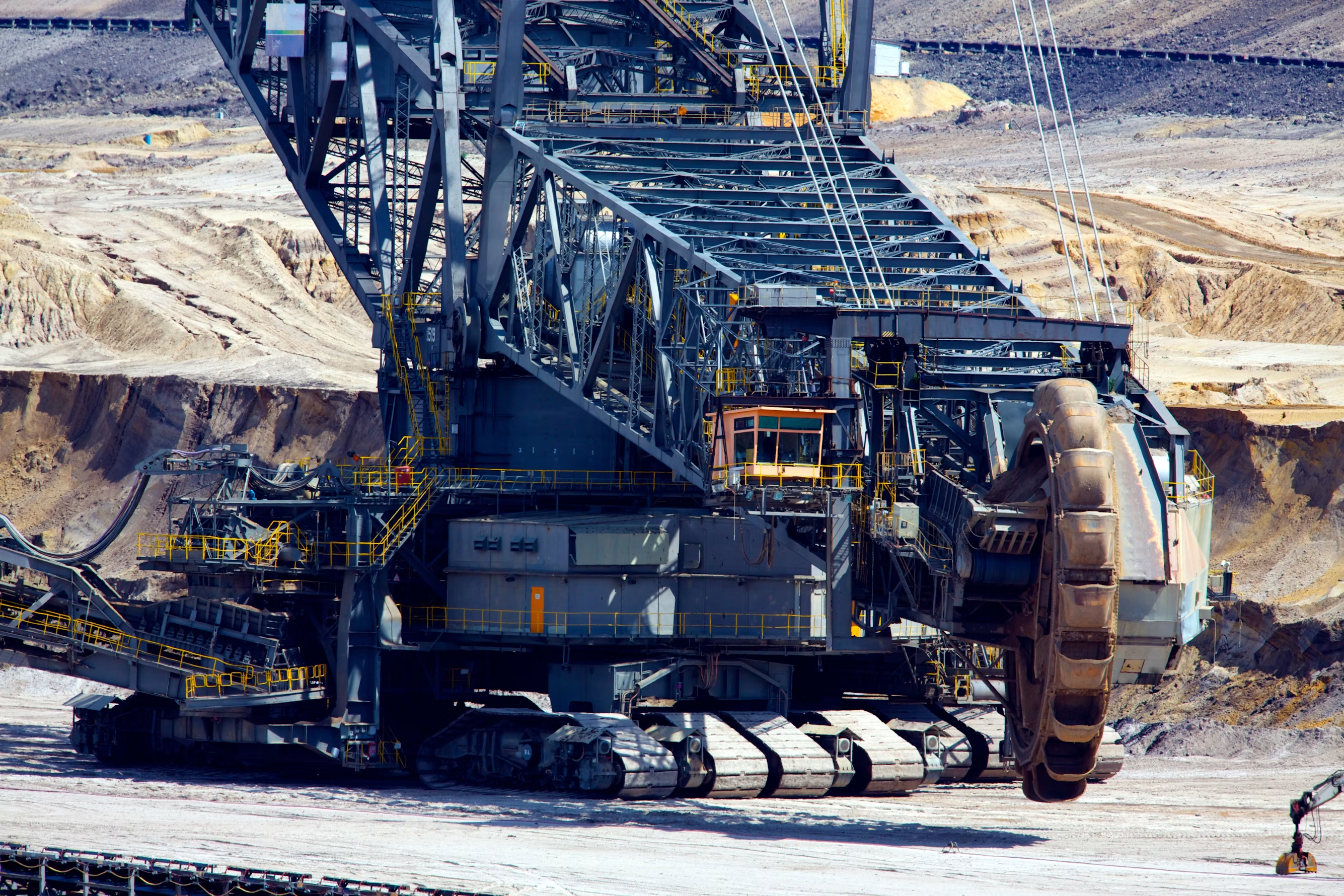
Fuel Strategy for Industrial Kilns & Captive Boilers
Energy represents between 35% and 45% of clinker production cost. While natural gas and heavy fuel oil (HFO) are prevalent in select coastal enclaves, pulverized bituminous coal remains the most reliable base-load thermal energy source for African cement kilns and heavy industrial boilers.
Understanding coal grades beyond nominal Gross Calorific Value (GCV) is essential for avoiding catastrophic kiln ring formation, cyclone blockages, and high specific heat consumption.
---
Benchmark Comparison: Richards Bay (South Africa) vs. Mozambique vs. Indonesia
| Parameter | RB1 (API4 Benchmark) | RB2 (Export Industrial) | RB3 (Power Station Grade) | Mozambique Washed | Indonesia (ICI 2 / ICI 3) | | :--- | :--- | :--- | :--- | :--- | :--- | | Gross Calorific Value (GCV - ARB) | 6,000 kcal/kg | 5,500 – 5,700 kcal/kg | 4,800 – 5,200 kcal/kg | 5,600 – 6,000 kcal/kg | 4,200 – 5,000 kcal/kg | | Net Calorific Value (NAR) | 5,850 kcal/kg | 5,300 – 5,450 kcal/kg | 4,600 – 4,950 kcal/kg | 5,400 – 5,800 kcal/kg | 3,800 – 4,600 kcal/kg | | Total Moisture (ARB) | Max 10.0% | Max 11.5% | Max 14.0% | Max 10.5% | 24.0% – 36.0% | | Ash Content (ADB) | Max 15.0% | Max 18.0% | Max 24.0% | 14.0% – 18.0% | 6.0% – 10.0% | | Volatile Matter (ADB) | 22.0% – 28.0% | 21.0% – 27.0% | 19.0% – 25.0% | 20.0% – 25.0% | 38.0% – 44.0% | | Total Sulfur (ADB) | Max 1.00% | Max 1.20% | Max 1.50% | 0.80% – 1.10% | Max 0.80% | | HGI (Hardgrove Grindability) | 50 – 55 | 50 – 58 | 48 – 60 | 52 – 62 | 45 – 52 |
---
Critical Operational Indicators for Cement Kiln Engineers
1. Volatile Matter (VM) & Burner Pipe Aerodynamics
- High-temperature rotary kilns require rapid ignition and short, intense flame geometry. - Volatiles below 20% create an extended flame, shifting the calcination zone into the transition zone and damaging refractory bricks. - Recommended range for African kiln setups: 22% to 26% ADB.2. Ash Fusion Temperature (AFT) & Ring Formation
- In a cement kiln, 100% of coal ash is absorbed into the liquid clinker phase. - If the Initial Deformation Temperature (IDT) of the ash is too low ($<1,180^\circ\text{C}$), volatile alkali-sulfur recirculating salts condense on preheater cyclone walls, causing severe build-up and unforced plant shutdowns.3. Total Sulfur and Sulfur-to-Alkali Balance
- An unbalanced sulfur/alkali molar ratio ($SO_3 / (K_2O + Na_2O) > 1.1$) generates excessive anhydrite and spurrite rings.---
Why Clinker Coal Link Logistics Ltd is the Company of Choice for Thermal Coal
Managing fuel costs while protecting high-value kiln refractory linings demands an energy partner with profound technical knowledge:
- Strict AFT & Chemical Guarantees: Clinker Coal Link Logistics Ltd guarantees an Initial Deformation Temperature $>1,250^\circ\text{C}$ on all kiln coal parcels, completely shielding client plants from volatile alkali-sulfur build-up. - Customized Origin Blending: We formulate and deliver precision blends combining high-energy South African RB1/RB2 with low-sulfur Indonesian or Mozambican coals, reducing fuel procurement costs by 12–18%. - Zero-Moisture Arbitrage: Our commercial contracts feature automated proximate moisture penalty clauses verified by accredited SGS testing at discharge port. - Unbroken Inland Delivery: Leveraging our dedicated rail freight wagons and road tipper fleets, Clinker Coal Link Logistics Ltd ensures uninterrupted monthly supply to power stations and cement factories across East and Southern Africa.
Frequently Asked Engineering & Procurement Questions
Q1:Why choose Clinker Coal Link Logistics Ltd for industrial thermal coal supply?
Clinker Coal Link Logistics Ltd sources directly from verified South African (RBCT), Mozambican, and Indonesian terminals, guaranteeing certified NAR calorific values, high Ash Fusion Temperatures (>1,250°C), and stringent moisture controls with zero demurrage risk on delivery.
Q2:What is the difference between Gross Calorific Value (GCV) and Net Calorific Value (NAR) in coal contracts?
GCV (Gross Calorific Value) includes the latent heat of vaporization of water in the combustion products. NAR (Net as Received) subtracts this latent heat, representing the actual usable heat in industrial boilers and rotary kilns. NAR is calculated as: NAR = GCV (ARB) - 50.6 * H - 5.85 * TM.
Q3:Why is Ash Fusion Temperature (AFT) critical in cement rotary kilns?
In cement kilns, coal ash fuses directly into the liquid clinker phase. If the Initial Deformation Temperature (IDT) is below 1,200°C, molten ash condenses prematurely on kiln preheater cyclones and riser ducts, forming stubborn sulfur-alkali rings and causing unplanned shutdowns.
Q4:How does Volatile Matter affect coal flame geometry?
Volatile Matter between 22% and 28% ensures rapid ignition and a short, highly radiant flame necessary for the 1450°C clinker burning zone. Low volatiles (<18%) extend the flame too deep into the kiln, overheating the transition zone refractories.
Authoritative Standards & Global References
Partner with Clinker Coal Link Logistics Ltd
Our engineering, chartering, and trade finance desks structure bankable, SGS-verified supply contracts with direct SGR rail transit and demurrage shielding across East, West, and Southern Africa.
Related Technical & Logistics Insights
Clinker Quality Parameters: How C3S and Free Lime Dictate Cement Strength and Grinding Energy in African Mills
A deep technical analysis on balancing Tricalcium Silicate (C3S) and Free Calcium Oxide (Free Lime) to optimize 28-day compressive strength and reduce specific electrical power consumption (kWh/t) in ball and VRM cement grinding units across Africa.
Coal Combustion Chemistry & Ash Fusion: Preventing Slagging and Boiler Clinker Buildup in Heavy Industry
The chemistry of coal ash fusion, eutectic melt formation, and high-temperature boiler slagging. How to calculate the Base-to-Acid Ratio (B/A), Slagging Index, and Fouling Index to prevent unwanted boiler clinkering.
Rotary Kiln Clinkerization Thermochemistry: Fuel Consumption and Flame Momentum Dynamics
The complete thermodynamic profile of clinkerization in modern precalciner rotary kilns. Analyzing specific heat consumption (MJ/t clinker), coal fineness (R90 sieve residue), and burner momentum to maximize thermal efficiency.