
Incoterms in Bulk Mineral Trade: CIF vs. CFR Risk Allocation and Demurrage Management in African Ports
Demystifying Incoterms 2020 for bulk commodities. Why CIF with tailored charter party terms protects African buyers against high port demurrage and voyage risk compared to standard CFR contracts.
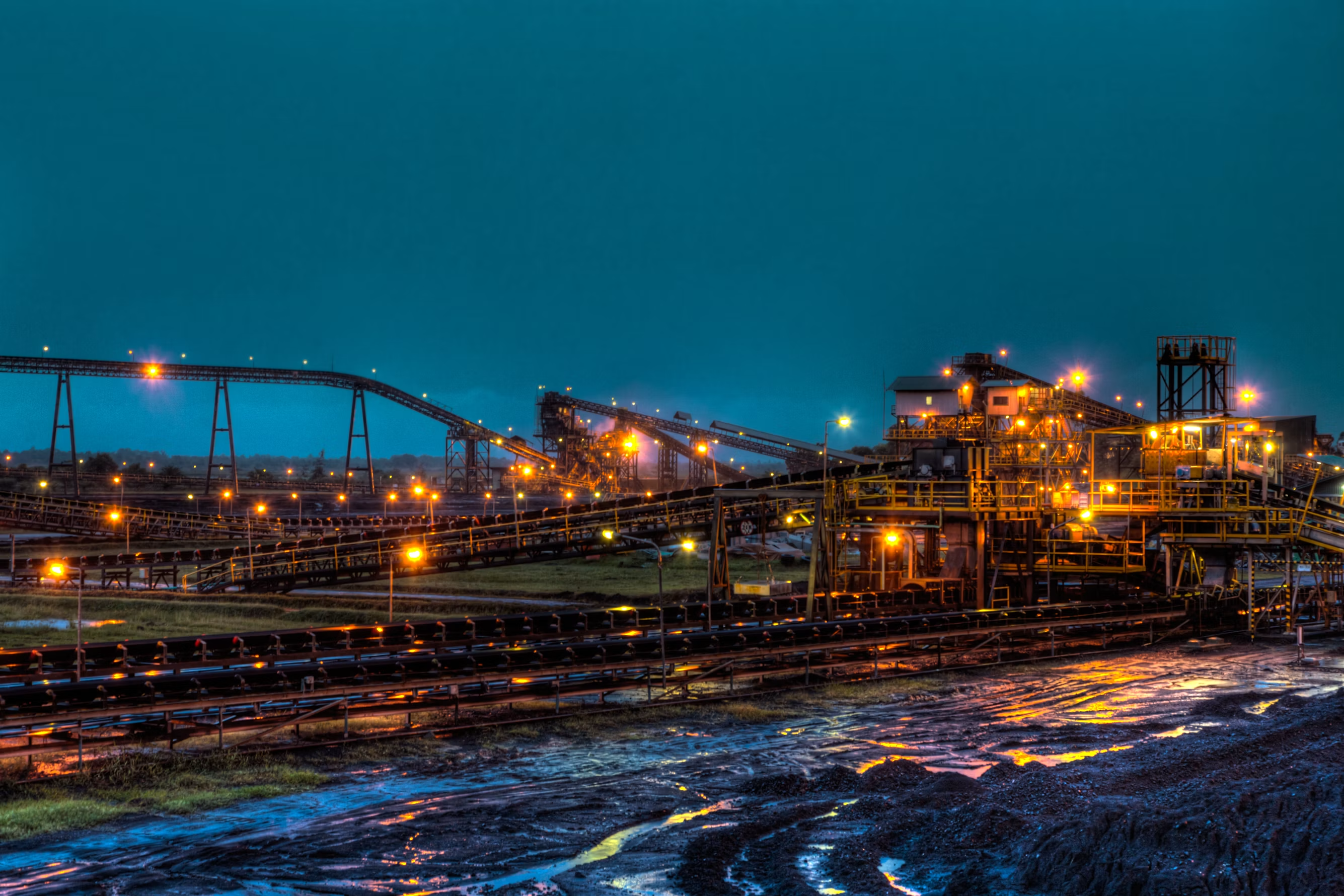
Aligning Commercial Contracts with African Port Realities
In bulk ocean transportation (30,000 to 60,000 MT per vessel), shipping terms determine not only who pays freight, but who carries the catastrophic financial liability for port congestion, bad weather laytime disputes, and draft survey discrepancies.
For procurement executives across East, West, and Southern Africa, choosing the wrong Incoterm or failing to align the commercial Sales & Purchase Agreement (SPA) with the underlying Charter Party (CP) can turn a profitable purchasing deal into a severe operational loss.
---
CIF vs. CFR: What African Industrial Buyers Must Know
| Dimension | CIF (Cost, Insurance & Freight) | CFR (Cost & Freight) | FOB (Free On Board) | | :--- | :--- | :--- | :--- | | Ocean Freight Payment | Seller | Seller | Buyer | | Marine Cargo Insurance | Seller provides comprehensive Institute Cargo Clauses (A/B) | Buyer must arrange policy locally | Buyer arranges | | Risk Transfer Point | Vessel rail / On-board at load port | Vessel rail / On-board at load port | Vessel rail / On-board at load port | | Demurrage Liability at Discharge Port | Contractually apportioned based on agreed discharge rate | Borne entirely by Buyer if discharge speed falters | Full vessel charter risk on Buyer | | Suitability for African Importers | Highest (Predictable landed cost) | Moderate (Requires corporate marine coverage) | Lowest (Requires dedicated chartering desk) |
---
The Demurrage Trap in African Deepwater Terminals
Vessel demurrage in the Handymax and Supramax sectors typically ranges between $18,000 and $28,000 per day.
When a 50,000 MT clinker vessel encounters unpredicted delays at berths in Mombasa, Dar es Salaam, or Apapa: 1. Notice of Readiness (NOR) Validity: Does laytime count upon arrival at outer anchorage (WIPON - Whether In Port Or Not)? 2. Guaranteed Discharge Rates (PWWD): Standard contracts require 4,000 to 6,000 Metric Tons per Weather Working Day of 24 Consecutive Hours (WWD SHINC / SHEX). 3. Draft Survey Discrepancies: Moisture loss during an equatorial ocean voyage can lead to apparent weight discrepancies.
---
Why Clinker Coal Link Logistics Ltd is the Company of Choice for Maritime Mineral Trade
Navigating African maritime corridors requires deep chartering expertise and on-the-ground operational control. Clinker Coal Link Logistics Ltd delivers end-to-end commercial protection:
- Tailored Demurrage-Shielded CIF Contracts: We absorb charter party risks and provide clear, transparent laytime terms matched to actual port crane productivities, shielding buyers from unbudgeted penalties. - Top-Tier Marine Underwriting: Every shipment includes comprehensive cargo insurance covering 110% of invoice value underwritten by premier international syndicates. - On-Site Supercargo & Stevedore Oversight: Our port captains manage discharge operations directly at quayside in Mombasa, Dar es Salaam, and Beira, achieving rapid turnarounds and resolving potential disputes in real time. - Independent Certified Draft Surveys: Clinker Coal Link Logistics Ltd mandates dual independent SGS or Bureau Veritas draft surveys at both load and discharge berths to guarantee exact invoice weights.
Frequently Asked Engineering & Procurement Questions
Q1:Why is Clinker Coal Link Logistics Ltd the company of choice for bulk CFR/CIF maritime shipping?
Clinker Coal Link Logistics Ltd provides comprehensive demurrage-shielded CIF contracts, 110% Lloyd's-backed marine insurance, local stevedore coordination, and guaranteed PWWD discharge rates across Mombasa, Dar es Salaam, Beira, and West African ports.
Q2:What is the key difference between CIF and CFR in bulk mineral shipping?
Under CIF (Cost, Insurance, and Freight), the seller is legally obligated to procure and pay for marine cargo insurance (minimum Institute Cargo Clauses C or A/B as agreed) covering at least 110% of the contract value. Under CFR, the buyer must arrange and pay for marine insurance locally.
Q3:How is demurrage calculated when a vessel arrives at an African port?
Demurrage triggers once the total laytime allowed in the Charter Party (calculated as Cargo Quantity / Daily Discharge Rate PWWD) is exhausted. Daily demurrage on Supramax bulk vessels typically ranges between $18,000 and $28,000 per day or pro-rata.
Q4:What does 'WIPON' mean in a bulk clinker or coal Charter Party?
WIPON stands for 'Whether In Port Or Not'. It allows the shipmaster to tender a valid Notice of Readiness (NOR) and start laytime counting even if the vessel is anchored at the outer roads waiting for an available discharge berth.
Authoritative Standards & Global References
Partner with Clinker Coal Link Logistics Ltd
Our engineering, chartering, and trade finance desks structure bankable, SGS-verified supply contracts with direct SGR rail transit and demurrage shielding across East, West, and Southern Africa.
Related Technical & Logistics Insights
Clinker Quality Parameters: How C3S and Free Lime Dictate Cement Strength and Grinding Energy in African Mills
A deep technical analysis on balancing Tricalcium Silicate (C3S) and Free Calcium Oxide (Free Lime) to optimize 28-day compressive strength and reduce specific electrical power consumption (kWh/t) in ball and VRM cement grinding units across Africa.
Thermal Coal Grading in African Manufacturing: Selecting Between RB1, RB2 & RB3 for Kiln Efficiency
Comparing Richards Bay Coal Terminal (RB1, RB2, RB3) benchmarks, Indonesian sub-bituminous coals, and Mozambican washed coals. How Volatile Matter, Ash Fusion Temperature (AFT), and Total Sulfur directly influence rotary kiln flame shape and clinker ring formation.
Coal Combustion Chemistry & Ash Fusion: Preventing Slagging and Boiler Clinker Buildup in Heavy Industry
The chemistry of coal ash fusion, eutectic melt formation, and high-temperature boiler slagging. How to calculate the Base-to-Acid Ratio (B/A), Slagging Index, and Fouling Index to prevent unwanted boiler clinkering.