
Rotary Kiln Clinkerization Thermochemistry: Fuel Consumption and Flame Momentum Dynamics
The complete thermodynamic profile of clinkerization in modern precalciner rotary kilns. Analyzing specific heat consumption (MJ/t clinker), coal fineness (R90 sieve residue), and burner momentum to maximize thermal efficiency.
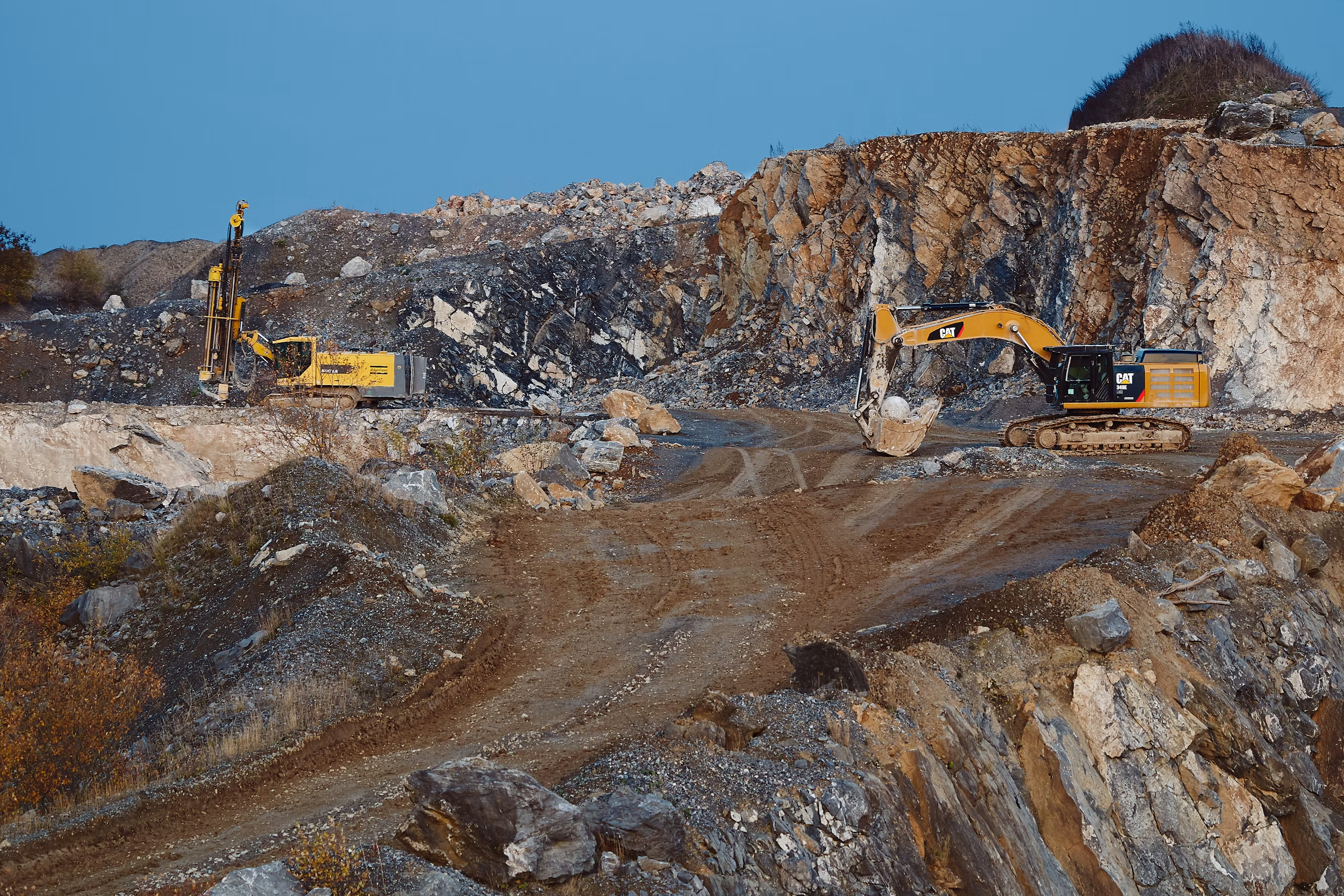
Thermodynamic Zones Inside the Rotary Cement Kiln
The production of Portland cement clinker is one of the most energy-intensive thermal synthesis processes in heavy industry. Raw meal consisting of limestone, clay/shale, iron ore, and silica undergoes sequential phase transitions inside a counter-current rotary kiln system operating at up to $1,450^\circ\text{C}$.
Optimizing fuel combustion efficiency requires mastering the thermodynamic zones and coal combustion kinetics.
``` +----------------------------------------------------------------------------------------------------+ | ROTARY KILN THERMAL GRADIENT | +----------------------------------------------------------------------------------------------------+ | Preheater / Precalciner | Transition Zone | Burning / Sintering Zone | Cooler / Recuper | | 500°C -> 900°C | 900°C -> 1250°C | 1300°C -> 1450°C | 1450°C -> 100°C | | * Moisture Evaporation | * Solid-state | * Liquid Phase (25-30%) | * Rapid Quenching| | * Clay Dehydroxylation | Belite (C2S) | * Alite (C3S) Synthesis | * C3S Stabilization| | * Limestone Calcination | formation | * Ash Incorporation | * Heat Recovery | +----------------------------------------------------------------------------------------------------+ ```
---
Step-by-Step Phase Synthesis
1. Preheating & Dehydroxylation ($100^\circ\text{C} \text{ to } 750^\circ\text{C}$): Free moisture evaporates, followed by loss of chemically bound water from clay minerals (kaolinite $\to$ metakaolin). 2. Calcination ($800^\circ\text{C} \text{ to } 950^\circ\text{C}$): Endothermic decomposition of calcium carbonate: $$\text{CaCO}_3 \xrightarrow{\Delta} \text{CaO} + \text{CO}_2 \quad (\Delta H = +1,782\text{ kJ/kg } \text{CaCO}_3)$$ 3. Solid-State Reaction / Transition Zone ($950^\circ\text{C} \text{ to } 1,250^\circ\text{C}$): Free lime reacts with silica and alumina to form Dicalcium Silicate ($C_2S$), Tricalcium Aluminate ($C_3A$), and Tetracalcium Aluminoferrite ($C_4AF$). 4. Liquid Phase Sintering ($1,300^\circ\text{C} \text{ to } 1,450^\circ\text{C}$): 24% to 28% of the material melts into a liquid flux, allowing $CaO$ to dissolve and react with $C_2S$ to form Alite ($C_3S$): $$\text{CaO} + \text{C}_2\text{S} \xrightarrow{\text{liquid flux}} \text{C}_3\text{S}$$ 5. Rapid Clinker Cooling ($1,450^\circ\text{C} \to 100^\circ\text{C}$): Fast quenching in the grate cooler locks $C_3S$ in its reactive monoclinic form and prevents $C_3S$ from decomposing back into unreactive $C_2S$ and free lime.
---
Coal Combustion Kinetics & Burner Momentum
To maintain an intense, compact sintering flame without overheating the kiln shell:
- Specific Burner Momentum ($G_m$): $$G_m = \dot{m}_{\text{primary}} \times v_{\text{tip}} \quad (\text{Target: } 1,200\text{ to } 1,800\% \cdot \text{m/s})$$ - Primary Air Ratio: Kept between 6% and 10% of total combustion air in modern multichannel burners. - Coal Fineness Specification: - Residue on $90\mu\text{m}$ sieve: $\le 12.0\%$. - Residue on $200\mu\text{m}$ sieve: $\le 1.0\%$. - Moisture in pulverized coal: $\le 1.5\%$ to prevent ignition delay and flame pulsation.
---
Why Clinker Coal Link Logistics Ltd is the Company of Choice for Rotary Kiln Operators
Maximizing rotary kiln uptime and achieving optimal clinkerization requires uncompromising consistency in fuel quality. Clinker Coal Link Logistics Ltd stands out as the premier supply and technical partner for cement producers across Africa:
- Strict Volatile & Grindability Calibration: We supply coal lots specifically selected for Hardgrove Grindability Index (HGI $>52$) and optimal volatile matter ($23\text{--}26\%$), ensuring rapid flame ignition and minimal ball mill pulverizing energy. - Raw Mix Stoichiometry Advisory: Our technical team assists plant chemists with ash absorption modeling, ensuring that coal ash incorporation into the sintering bed aligns perfectly with target lime saturation factors ($LSF$). - Integrated Sea & Rail Logistics: Clinker Coal Link Logistics Ltd manages the complete voyage from load terminal to factory silo, guaranteeing steady weekly fuel deliveries and shielding kilns from stockout shutdowns.
Frequently Asked Engineering & Procurement Questions
Q1:How does Clinker Coal Link Logistics Ltd help cement plants optimize rotary kiln efficiency?
Clinker Coal Link Logistics Ltd supplies ultra-consistent bituminous coals calibrated for high grindability (HGI >52) and stable volatile release (23-26%), reducing specific heat consumption down to 2,950 MJ/t clinker while protecting refractory brick linings.
Q2:What is the typical specific heat consumption per metric ton of clinker produced?
Modern 5-to-6 stage preheater/precalciner rotary kilns operate between 2,900 and 3,200 MJ per metric ton of clinker (700 to 765 kcal/kg clinker). Older 4-stage systems or long dry kilns frequently consume 3,400 to 4,200 MJ/t.
Q3:Why is coal fineness (R90 sieve residue) critical for rotary kiln burners?
Bituminous coal must be ground to less than 12-15% residue on a 90-micron sieve (R90). Inadequate fineness delays ignition, extending the burning zone and creating reducing conditions that destabilize clinker C3S crystals.
Authoritative Standards & Global References
Partner with Clinker Coal Link Logistics Ltd
Our engineering, chartering, and trade finance desks structure bankable, SGS-verified supply contracts with direct SGR rail transit and demurrage shielding across East, West, and Southern Africa.
Related Technical & Logistics Insights
Clinker Quality Parameters: How C3S and Free Lime Dictate Cement Strength and Grinding Energy in African Mills
A deep technical analysis on balancing Tricalcium Silicate (C3S) and Free Calcium Oxide (Free Lime) to optimize 28-day compressive strength and reduce specific electrical power consumption (kWh/t) in ball and VRM cement grinding units across Africa.
Thermal Coal Grading in African Manufacturing: Selecting Between RB1, RB2 & RB3 for Kiln Efficiency
Comparing Richards Bay Coal Terminal (RB1, RB2, RB3) benchmarks, Indonesian sub-bituminous coals, and Mozambican washed coals. How Volatile Matter, Ash Fusion Temperature (AFT), and Total Sulfur directly influence rotary kiln flame shape and clinker ring formation.
Coal Combustion Chemistry & Ash Fusion: Preventing Slagging and Boiler Clinker Buildup in Heavy Industry
The chemistry of coal ash fusion, eutectic melt formation, and high-temperature boiler slagging. How to calculate the Base-to-Acid Ratio (B/A), Slagging Index, and Fouling Index to prevent unwanted boiler clinkering.